

Generative AI
Enterprise LLM
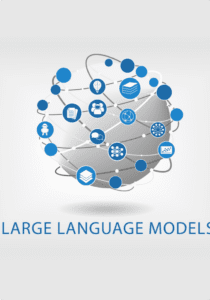
Enterprise
Knowledge Base
Gen AI Workflow Automation
Gen AI Applications
Generative AI is the backbone of the Agentic Enterprise, enabling businesses to create intelligent, autonomous agents that can respond to complex tasks, predict needs, and deliver real-time insights. However, for an enterprise to truly unlock the potential of this technology, a carefully structured approach is essential:
- Selecting the right Large Language Model (LLM)
- Integrating enterprise knowledge base
- Ensuring data security
- Scalable orchestration framework to support multiple agents
1. Importance of Selecting the Right LLM Model
The choice of LLM is critical, as it defines the capabilities of AI agents across the enterprise. The model must be tailored to the business’s specific domain needs: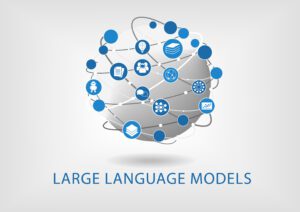
- Open-Source vs. Proprietary Models: Open-source models, like LLAMA or Mistral, offer greater flexibility for customization and can be fine-tuned to meet enterprise-specific needs. Proprietary models, like GPT, may come with pre-built capabilities but offer limited customization and require careful evaluation of cost, scalability, and functionality.
- Domain-Specific Expertise: LLMs must be fine-tuned on relevant industry data to understand specific terminology, compliance requirements, and nuances in customer queries. For example, a healthcare company would need models trained on medical literature, while a finance company would require a model with deep knowledge of financial regulations and terms.
Selecting an LLM that aligns with both the technical and operational requirements of the enterprise ensures a strong foundation for building capable, intelligent agents
Enterprise Knowledge Base Integration and Training
Beyond choosing the right model, integrating enterprise-specific knowledge is essential for AI agents to deliver accurate, contextual insights:
- Enterprise Data Integration: LLMs require seamless access to various data sources, such as CRM systems, supply chain data, and financial records. Creating a Unified Data Layer allows the LLM to pull data in real time, keeping responses and recommendations relevant.
- Training on Enterprise Data: LLMs need to be continuously fine-tuned on the enterprise’s proprietary data, policies, and workflows. This ensures that AI agents understand the context and deliver responses aligned with the business's unique requirements. Regular updates and retraining on new data also help the model adapt to changes in customer behavior and industry trends.
Data Security and Governance
Data security and governance are paramount when working with sensitive enterprise data. As LLMs process critical information, enterprises must prioritize:
- Data Ownership and Control: Enterprises need to maintain control over data flow and access within AI systems, ensuring that only authorized personnel and agents access sensitive information.
- Privacy Compliance: Integrating security protocols to comply with privacy regulations (e.g., GDPR, HIPAA) is essential. Implementing data anonymization, encryption, and access controls safeguards sensitive information and builds trust with customers and stakeholders.
- Auditability: Enterprises must establish processes for tracking AI model decisions, training data, and agent activities to ensure transparency and compliance with internal and external standards.
Integrating Disparate Enterprise Knowledge Bases into Agentic Architecture
- At AgileIT.AI, we provide a systematic approach to unify and secure enterprise knowledge bases, laying the foundation for intelligent, AI-driven applications. Our design process includes the following key steps:
- Unified, Secure Data Access Layer: We first create a unified, secure data access layer that connects disparate databases and data stores across the enterprise (e.g., R&D, Supply Chain, Manufacturing, Sales, Finance). This layer enables seamless access to enterprise knowledge, breaking down data silos while ensuring data security and compliance.

- LLM Training and Fine-Tuning: With the data access layer established, we then train and fine-tune the selected Large Language Model (LLM) on this comprehensive enterprise knowledge base. This ensures that the LLM is specifically tailored to the organization’s unique data and operational needs.
- Foundation for Future Enterprise Applications: Our approach provides the foundational architecture needed to develop and deploy future enterprise workflow applications. AI-driven agents can then leverage the unified data layer and trained LLM to optimize workflows, support decision-making, and enhance operational efficiency across the business.
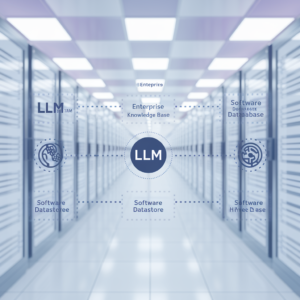
With AgileIT.AI’s expertise, enterprises gain a robust, secure infrastructure that maximizes the value of their data, empowering them to build scalable, intelligent applications tailored to their specific business goals.
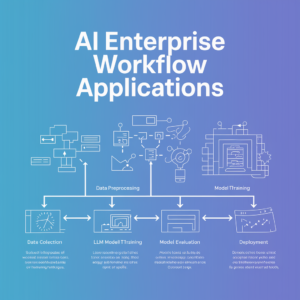
Agentic Enterprise AI Workflows with AgileIT.AI
Once AgileIT has deployed and fine-tuned the enterprise LLM within a secure data framework, the enterprise is primed to automate repetitive tasks through AI-driven workflows. Our focus at AgileIT is to guide organizations in prioritizing and implementing workflows that drive the highest business efficiencies and deliver measurable value. Key points of our approach include:
- Prioritizing High-Impact AI Workflows: AgileIT helps enterprises identify and prioritize the workflows that will yield the greatest efficiency gains. By evaluating business processes across functions, we ensure that AI is deployed where it has the most significant impact.
- AI Workflow Automation Across Functional Areas: Our expertise spans all core functional areas of an enterprise—whether in Operations, HR, Finance, Customer Support, Sales, or Supply Chain. We work closely with organizations to create automated workflows that enhance cross-functional collaboration and streamline end-to-end processes.
- Internal Workflow Efficiencies to Boost Employee Productivity: AI-driven workflows reduce repetitive tasks, allowing employees to focus on high-value work. This not only boosts productivity but also fosters a more innovative, engaged workplace where resources are optimized.
- External Workflow Efficiencies for Enhanced Customer Satisfaction: AI workflows enable enterprises to provide faster, more accurate responses to customers, improving customer experience and satisfaction. AgileIT’s solutions empower businesses to be proactive, ensuring customers receive the support and services they need seamlessly.
- Driving Revenue Growth and Improving the Bottom Line: By enhancing both internal and external efficiencies, our approach contributes directly to business growth. AI workflows help increase revenue opportunities while driving down operational costs, resulting in improved profitability.
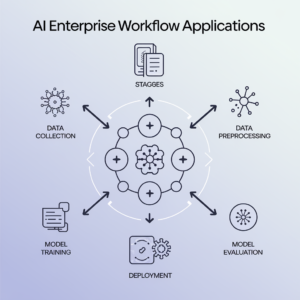
At AgileIT, our goal is to set enterprises on a path of sustainable AI-driven transformation. Through careful planning, prioritization, and deployment, we enable businesses to realize the full potential of AI workflows, benefiting both employees and customers and ultimately driving business growth and success.
Agentic AI Applications
Once enterprises have successfully integrated and trained an LLM on their knowledge bases across silos, built on a secure common data access layer, they are ready to develop and deploy Agentic AI applications. These applications enable automation across a range of internal and external workflows, delivering measurable business efficiencies. Key applications include:
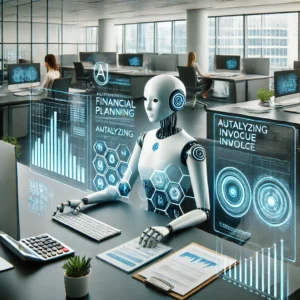
- HR Automation: Streamline HR functions such as employee onboarding, document management, and benefits inquiries, enabling HR teams to focus on strategic initiatives.
- Financial Applications:
- Invoice Analysis and Autopay: Automate invoice processing, flag discrepancies, and initiate payments, reducing manual labor and improving financial accuracy.
- Expense and Budget Management: AI-powered budgeting and expense tracking optimize financial planning and cost control.
- External Customer Service Automation: Deploy AI agents to handle customer inquiries, troubleshoot issues, and deliver 24/7 support, enhancing customer satisfaction and reducing wait times.
- Sales Automation:
- Lead Scoring and Follow-Up: Use AI to prioritize leads, recommend personalized follow-up actions, and optimize sales pipelines.
- Sales Forecasting and Analysis: Generate real-time forecasts and analyze trends to improve revenue planning and resource allocation.
- Internal Help Desk Automation: Automate responses to employee inquiries on IT support, HR, and policy questions, reducing wait times and improving internal service quality.

- Supply Chain Automation: Enable real-time inventory tracking, order management, and supplier coordination, enhancing the responsiveness and resilience of the supply chain.
These Agentic Applications can be deployed gradually, based on enterprise priorities and business needs, providing a scalable approach to digital transformation. AgileIT.AI partners with enterprises to implement and refine these solutions, ensuring that each AI-driven application aligns with strategic goals, drives efficiencies, and contributes to long-term growth.