

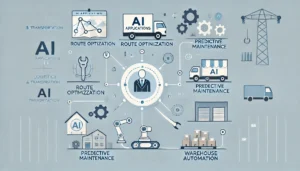
The Logistics and Transportation industry is undergoing a transformative shift, with AI playing a pivotal role in improving operational efficiency, reducing costs, and enhancing customer satisfaction. Below is a detailed overview of AI applications tailored to meet the needs of this segment.
AI Applications for Logistics and Transportation
- Route Optimization
- AI uses real-time traffic data, weather conditions, and delivery schedules to determine the most efficient routes.
- Example: Logistics companies optimize last-mile deliveries to reduce fuel consumption and delivery times.
- Predictive Maintenance
- AI monitors vehicle performance and predicts potential failures, ensuring timely maintenance and minimizing downtime.
- Example: Fleet operators use IoT sensors and AI to predict tire wear or engine issues.
- AI monitors vehicle performance and predicts potential failures, ensuring timely maintenance and minimizing downtime.
- Supply Chain Visibility
- AI-powered systems track shipments in real-time, providing transparency and alerts for delays or disruptions.
- Example: Real-time tracking of goods across international borders with proactive delay management.
- Demand Forecasting
- AI analyzes historical data and market trends to predict demand, enabling better inventory and resource planning.
- Example: Predicting peak seasons for shipping and adjusting fleet availability accordingly.
- Autonomous Vehicles
- AI enables self-driving trucks and delivery drones, reducing reliance on human drivers and cutting operational costs.
- Example: Autonomous trucks transporting goods across highways or drones delivering parcels in urban areas.
- Warehouse Automation
- AI-powered robots and systems streamline warehouse operations, from inventory management to order picking.
- Example: Robotic arms powered by AI pick and pack items more efficiently than manual labor.
- Freight Matching
- AI platforms match freight with available carriers, optimizing load capacity and reducing empty miles.
- Example: Automated systems match shippers with trucks based on load size and destination.
- Risk Management
- AI identifies risks such as theft, delays, or accidents and provides mitigation strategies.
- Example: Predicting theft-prone routes and adjusting plans to secure cargo.
- Customer Experience Enhancements
- AI-driven chatbots and systems provide real-time updates, answer queries, and handle complaints efficiently.
- Example: Chatbots notify customers of package delivery status and estimated arrival times.
- Sustainability Initiatives
- AI optimizes fuel consumption, reduces emissions, and promotes greener transportation practices.
- Example: AI algorithms suggest energy-efficient transportation modes and reduce carbon footprints.
Multi-Cloud Migration
Leveraging extensive experience in migrating financial institutions to the cloud, AgileIT.ai emphasizes a strategic approach:
- Strategic IT Target Goals: We collaborate with clients to define clear goals that extend beyond core banking systems, guiding a phased transformation roadmap.
- Gradual Transformation: By adopting a phased approach, we mitigate risks, optimize investments, and ensure timely realization of business outcomes.


Data Migration and Analytics
AgileIT.ai specializes in:
- Data Migration: Seamlessly transferring data across various platforms while maintaining integrity and security.
- Data Analytics: Utilizing tools such as Power BI, Tableau, Apache Spark, and Apache Kafka to derive actionable insights and support informed decision-making.
- Secure Common Access Layer: Establishing a unified access layer that integrates disparate data stores, enhancing data accessibility and security.
Generative AI Large Language Models
We empower financial institutions by:
- AI Integration: Implementing Generative AI and LLMs atop existing data frameworks to analyze and enhance both internal and external processes, identifying efficiencies and areas for improvement.
- Agentic AI Applications: Developing a new class of applications that leverage AI capabilities to automate tasks, provide insights, and enhance user experiences.
Selecting an appropriate Generative AI Large Language Model (LLM) platform is crucial for financial institutions, given the sector's stringent security requirements and diverse operational needs. Key considerations include:
1. Security and Data Privacy
- Data Control: Financial institutions must ensure complete control over datasets used for LLM training to maintain confidentiality and comply with regulations. Implementing robust encryption and access controls is essential to protect sensitive information.
- Regulatory Compliance: Adherence to industry standards and legal requirements, such as GDPR or CCPA, is mandatory. Regular audits and compliance checks should be integrated into the AI deployment strategy.
2. Performance and Accuracy
- Task Relevance: Evaluate the LLM's proficiency in handling specific tasks pertinent to banking operations, such as customer service automation, fraud detection, and financial forecasting.
- Evaluation Metrics: Utilize metrics like precision, recall, F1 score, and domain-specific benchmarks to assess model performance.
3. Scalability and Integration
- Infrastructure Compatibility: Ensure the LLM platform can seamlessly integrate with existing IT infrastructure and support scalability to accommodate future growth.
- Interoperability: The platform should be compatible with current systems and workflows to facilitate smooth integration and operation.
Single vs. Multiple LLMs
The decision to deploy a single LLM or multiple specialized models depends on the institution's specific requirements:
- Single LLM Approach: Utilizing one comprehensive model can simplify management and ensure consistency across applications. However, it may lack the specialized capabilities needed for certain tasks.
- Multiple LLMs Approach: Implementing specialized models for distinct functions can enhance performance in specific areas but may increase complexity and resource demands.
Financial institutions often adopt a centrally led generative AI operating model, where a central team oversees AI solutions' design and execution, ensuring alignment with organizational goals and efficient resource utilization. This approach balances the benefits of both single and multiple LLM deployments.
Open Source vs. Proprietary LLMs
Choosing between open-source and proprietary LLMs involves several considerations:
- Open-Source LLMs: Training and hosting open-source models on private cloud infrastructure offer greater control over data and customization. However, this approach requires substantial resources and expertise to manage effectively.
- Proprietary LLMs: These models often come with vendor support and may offer superior performance out-of-the-box. Yet, they might present limitations in data control and customization options.
Some financial institutions opt for a hybrid approach, leveraging open-source models for tasks requiring high customization and control, while utilizing proprietary models for general-purpose applications. This strategy allows for flexibility and optimization based on specific use-case requirements.

Agentic AI Financial Apps
In the rapidly evolving financial sector, integrating Agentic AI applications is essential for banks, insurance companies, and financial institutions aiming to enhance efficiency, customer satisfaction, and competitiveness. Key areas where Agentic AI can be transformative include:
1. Workflow Automation Applications
Agentic AI streamlines complex processes, reducing manual effort and minimizing errors. Examples include:
- Loan Processing: Automating data collection, verification, and approval workflows accelerates loan approvals and reduces processing times.
- Fraud Detection: AI systems monitor transactions in real-time, identifying suspicious activities and alerting relevant teams promptly.
- Regulatory Compliance: Automating compliance checks ensures adherence to regulations, reducing the risk of penalties and enhancing reporting accuracy.
2. Customer Service Automation
Agentic AI enables 24/7 customer support through intelligent systems that handle inquiries and provide personalized assistance. Benefits include:
- Chatbots and Virtual Assistants: These tools manage routine queries, guide customers through processes, and escalate complex issues to human agents when necessary.
- Personalized Interactions: AI analyzes customer data to offer tailored advice and product recommendations, enhancing the customer experience.
3. Marketing and Sales Automation
AI-driven applications optimize marketing strategies and sales processes by:
- Customer Segmentation: Analyzing customer data to identify segments for targeted marketing campaigns.
- Predictive Analytics: Forecasting customer behaviors and preferences to tailor product offerings and promotions.
- Lead Scoring: Evaluating potential customers based on engagement and likelihood to convert, enabling sales teams to prioritize efforts effectively.
4. Risk Management
Agentic AI enhances risk assessment and management through:
- Credit Scoring: Analyzing diverse data sources to assess creditworthiness more accurately.
- Market Analysis: Monitoring market trends and economic indicators to inform investment strategies and risk mitigation plans.
5. Financial Advisory Services
AI-powered advisory platforms provide customers with personalized financial planning and investment advice, democratizing access to financial expertise.
6. Document Processing
Automating the extraction, analysis, and management of information from documents such as contracts, forms, and statements reduces manual workload and errors.
By developing and deploying these Agentic AI applications, financial institutions can achieve significant operational efficiencies, deliver superior customer experiences, and maintain a competitive edge in the industry.
Testimonials
Vivamus magna justo, lacinia eget consectetur sed, convallis at tellus. Praesent sapien massa, convallis a pellentesque nec, egestas non nisi. Curabitur aliquet quam id dui posuere blandit Cras ultricies ligula sed magna dictum porta.

Vivamus magna
Lacinia eget
Vivamus magna justo, lacinia eget consectetur sed, convallis at tellus. Praesent sapien massa, convallis a pellentesque nec, egestas non nisi. Curabitur aliquet quam id dui posuere blandit Cras ultricies ligula sed magna dictum porta.

Vivamus magna
Lacinia eget